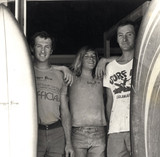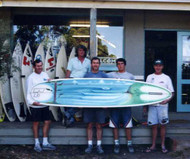
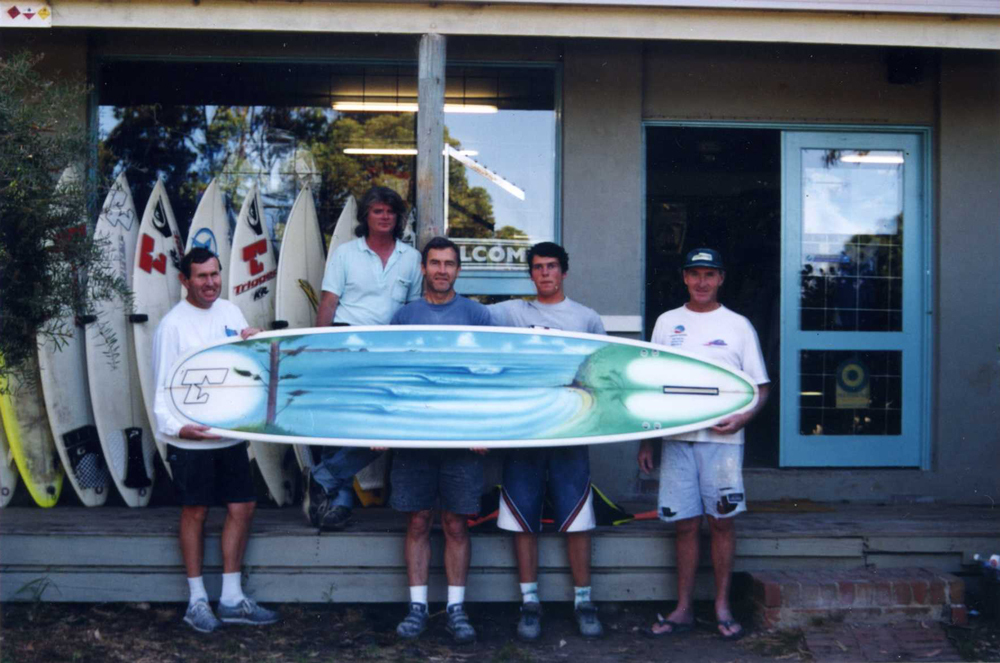
Our Pt. Leo manufacturing team with the Michael Marchant Crunchy Pt. mural on display, 2005. From left to right: Al Francis, Michael Marchant, John Jolly, Adam Butler, Phil Trigger.
Al Francis has been with us part-time since ’73 and full-time since ’85. During this time, Al has been responsible for most of the repair work, but he has also shaped and glassed a few boards along the journey. His work is of such a high quality that sometimes it's even hard for us to spot where a board has been repaired. Like the Traveling Wilburys, he packs one board bag with surfboards and the other with guitars (his passion) for his Maldives Mania trips. There are not too many Aussies who could match his frequency, and he also manages a yearly pilgrimage to Ulladulla.
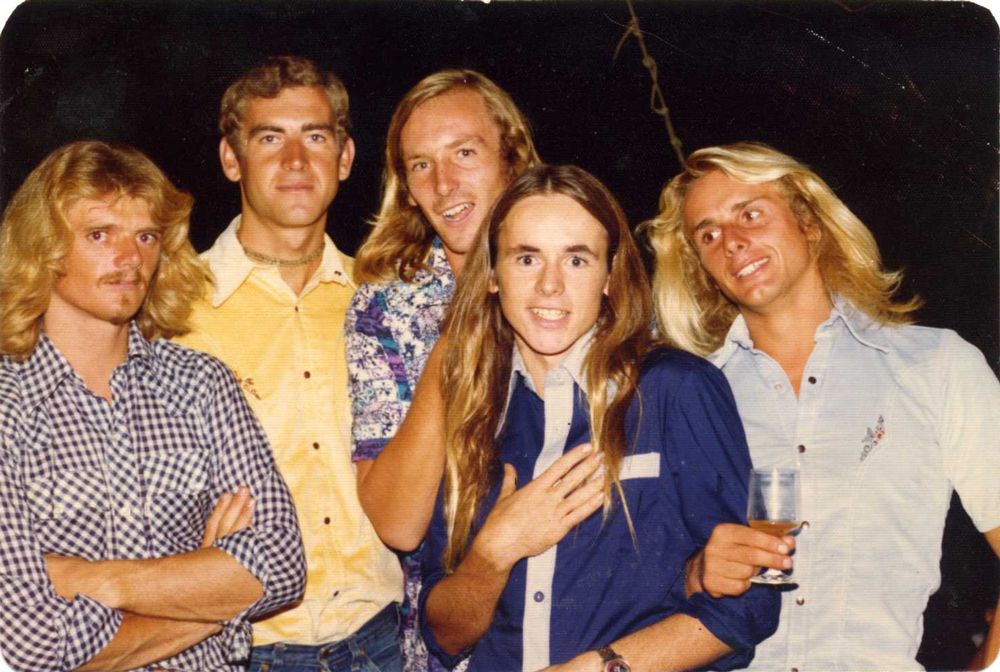
The Coolart Farm Crew: Michael, John, Paul, Dale, and Ronnie. John Jolly has glassed our surfboards for the past 35 years, and because he takes so much pride in every step of the production process, his contribution is first-class. In 1971, he and Dale Evans moved down to a farm at the southern end of Coolart Rd. in Somers (most likely the first surfers to follow their dream in this area), where they chased the waves and made surfboards, Morning of the Earth style. No one, not even Phil and myself, has surfed the Point more than John, but it’s the bigger waves that bring out his hellman attitude. He’ll paddle 20 minutes out to Sunset at Flinders and surf 10-to-12-foot waves completely on his lonesome (he must be nuts). On a late-70s surf safari to Puerto Escondido in Mexico with Cocky and Stretch Bingham, I’m told he was taking 10-to-15-foot drops, bouncing off the bottom, and charging back out for more.
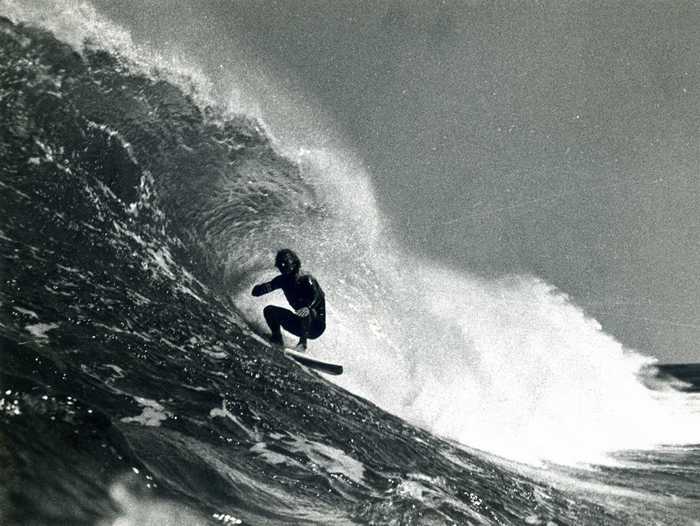
John Jolly, Express Point, Oke Pro Comp, 1978. (This photo was featured in Tracks Magazine.)
In 1972, John and Mick Schaffer traveled up the coast to Lennox Head. They were lucky enough to get bogged on the original muddy track that ran from the Surf Life Saving Club. With the help of the occupants of two cars stuck behind them, they all got through to the Point. The reward was classic Lennox with a crowd of only six, featuring none other than Nat Young, Bob McTavish, George Greenough, and Baddy Treloar. What a good mixer John is! Some say JJ tends to get locked in on certain trips (since ’72, he has holidayed at Angourie for two weeks on 35 separate occasions). Having stayed with him on a few of these trips, I can understand why. The answer is simple: it’s a fabulous place for waves and a little bit off the beaten track.
Chatting recently with the boys at the factory about Michael Peterson’s passing, John recalled paddling out to join a lone surfer at Anga in 1975. It was the man of the moment, M.P., seeking some solitude after his three Easter Bells wins. Unfortunately, he paddled in after just a few waves and even fewer words.
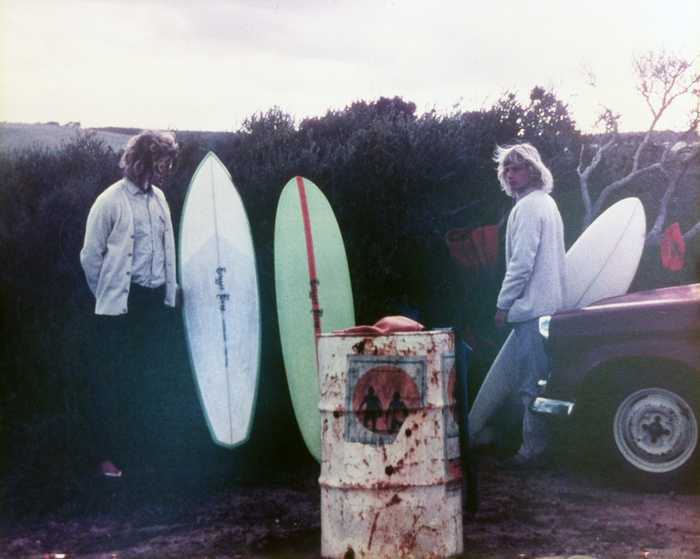
Bells Car Park, 1972. John Jolly and Ronnie Roozen, aged 17.
Morning of the Earth had just been released. Photo taken by Dale Evans. Adam Butler sanded, polished, and ran the Leo store when the rest of the team snuck off for a surf at the Rock. He now runs a very successful garden maintenance business in Red Hill and owns his own home, but rarely surfs.
Michael Marchant was a very imaginative surfer, multi-talented, and, as you can see from his mural, quite artistic. His surfing history can be linked to the Alaia surfboards—thin wooden surfboards used by the ancient Hawaiians for hundreds of years, yet virtually unsighted from 1900 until 2005 when reintroduced by Tom Wegener. Believe it or not, Mick’s first surfboard was a 1-inch solid timber version cut from an old dunny door with a timber fin screwed onto the bottom, and he surfed it at Pines in 1968. I just wish I had been there to witness that historic moment.
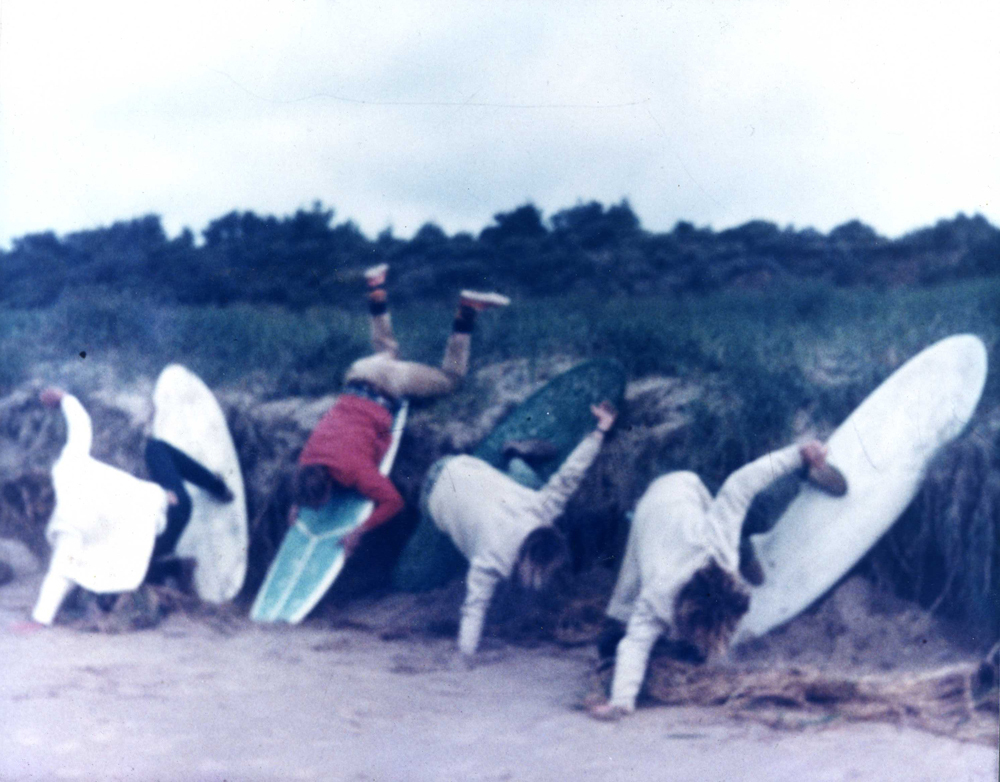
The Crew fooling around at First Reef.
By the early 70s, Michael was one of the very best Peninsula surfers, with placings in a couple of State round Open finals. However, free surfing in a contest area cost him a two-year expulsion from the Australian Surfing Association, and, bitterly disappointed, he never competed again. He continued to love his surfing, becoming an exceptional tube rider because of his ability to switch feet and get barreled as a goofy.
Some blessed with artistic talent can be kinda quirky, but not Michael; he had more of a connection with the Dreamtime and was a great storyteller, not dissimilar to Phil Grace. We used to pick Mick up and take him surfing, and because we were his mates, he let on that he should be called "the Dolphin," as Wayne Lynch was already called "the Fish." "Walrus" and "Seal" were all we offered, which wasn’t very generous on our behalf, but at least we kept his feet grounded while his imagination and passion for the ocean went full steam ahead.
Even though Mick was extremely close to his family (later in life caring for his mother and also spending large chunks of time helping his sisters), he left home at 16 and went to work for an abalone diver living in Shoreham. On one summer’s evening, he invited Ted Bainbridge and me around to watch him glass his new board. It was an open-air affair with a baker's dozen of keen young grommets from the Shoreham caravan park all gathered around. Lighting came in the form of a candle placed right on the board, which in turn drew an army of inquisitive moths to the sticky resin that Mick furiously applied. It literally was a backyard board. We held back a chuckle until we were back in the car, and then, 600 metres down the road, an oversized cat charged our car, hitting the side with an almighty thud. Mick certainly could conjure up some magic and entertain a crowd.
Driving Mick to work at Chelsea, there was always a sparkle in his eye when he told me one of his stories. He had a very smart dog called Rampa who, when pushed onto a wave at First Reef, would get barreled. Of course, we never witnessed the event, but I’m sure it happened. One time he was surfing at Portsea when he noticed a much larger dog beating up on Rampa. The smaller dog retreated to the water as Mick paddled in, while the big bully in pursuit was cleaned up in the shorebreak, then lay motionless on the sand struggling to recover. Rampa was quick to celebrate by raising his leg and peeing on the defeated foe.
Mick's talent as an artist can be seen in the ocean-mural themes on boards he shaped for us in the seventies, as well as pieces like the one pictured at the top from 2005. Quite a few of our stickers also came from his portfolio. Michael Marchant is currently living at St Helens in Tasmania, doing some surfing, painting, and catching up with two of his best mates from the seventies, Ronnie Roozen and Chris Wells.
Triggs