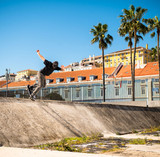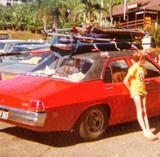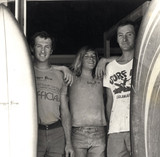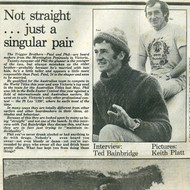
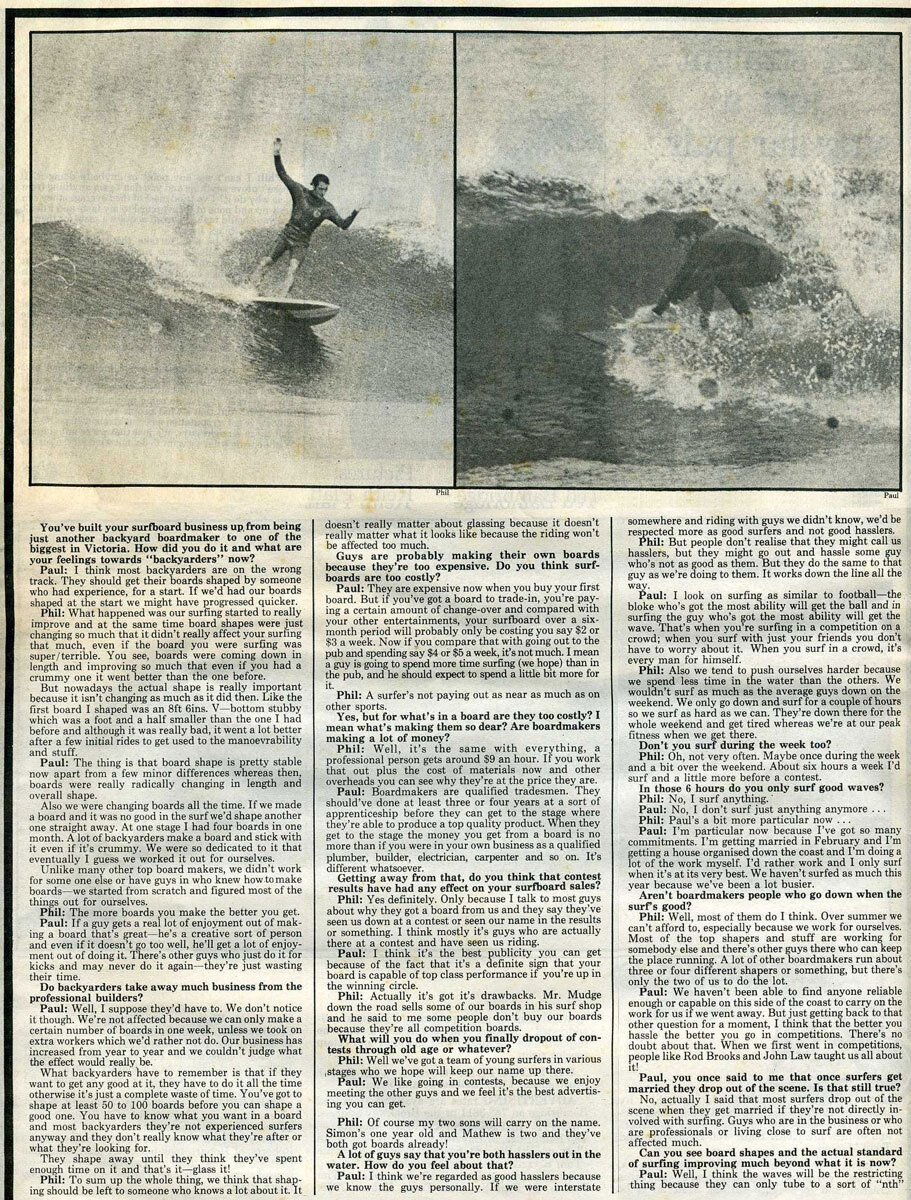
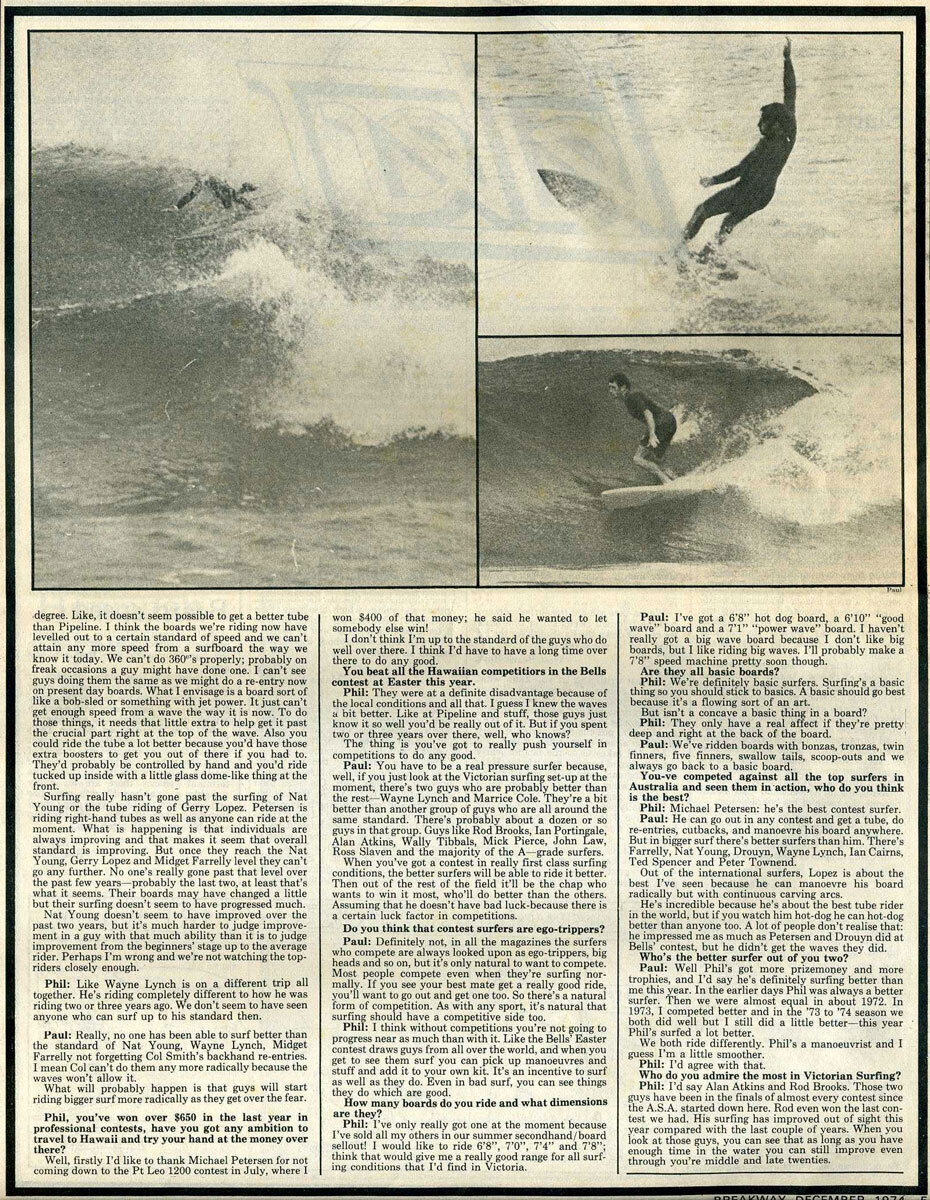
Phil and I did an interview for Breakway Surfing Magazine in the Mid 70’s and a few photos were required to go with the story. Ted Bainbridge, Phil and my self discovered some really hollow waves on a very shallow bank 50 metres up from Snatches down in Rye. The Snaps are of Ted and I, taken by Keith Platt.
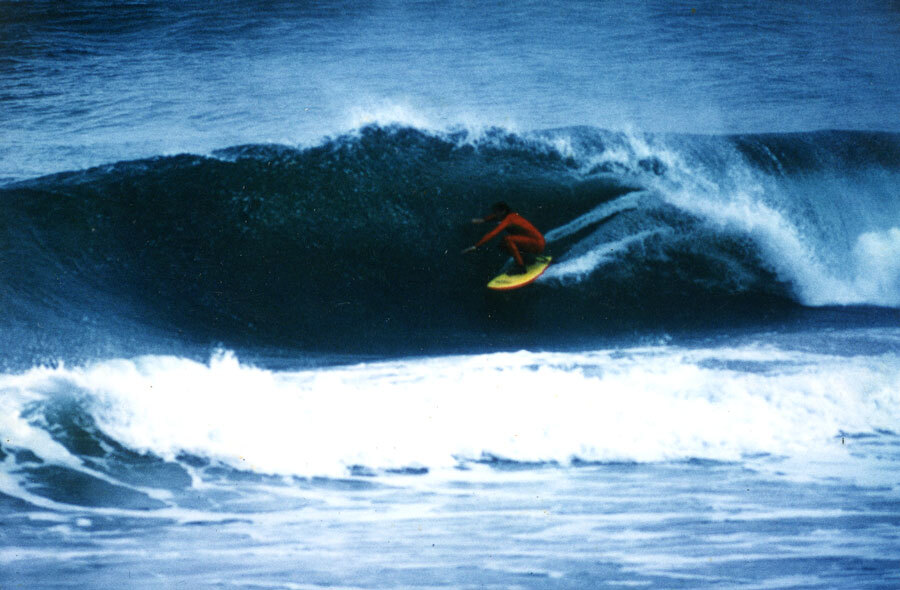
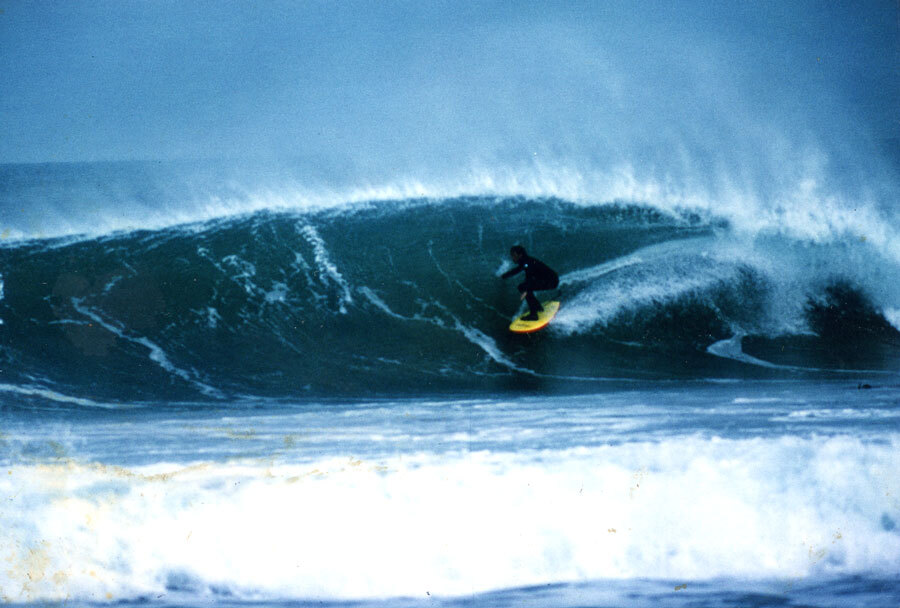
I was riding a 6’6″ Stinger with a red bottom and a yellow deck, which I regretfully sold to an up and coming surfer from Balnarring. This board was one of my very best and I tried unsuccessfully to regain it for a year or so afterwards.
We've extracted the full interview from these scans which can be found further down the page.
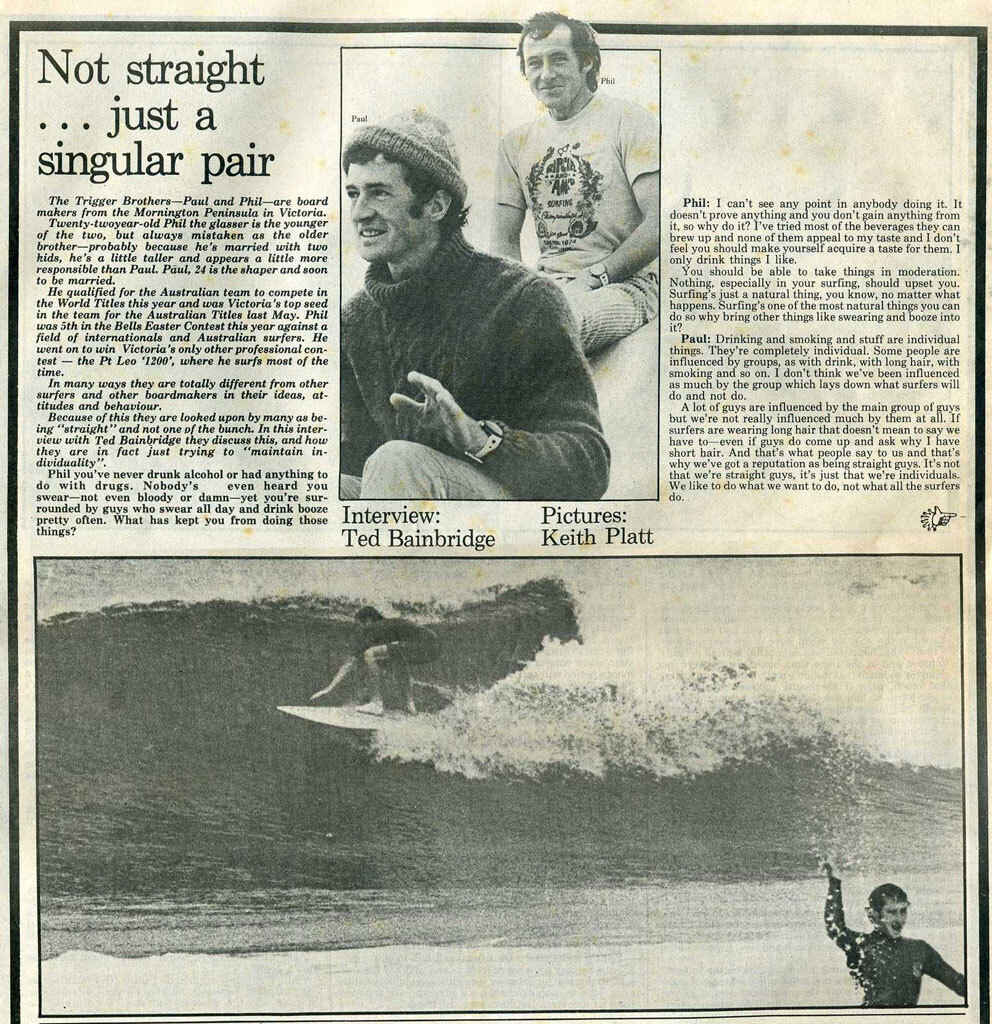
Not straight ... just a singular pair
The Trigger Brothers—Paul and Phil—are board makers from the Mornington Peninsula in Victoria.
Twenty-two-year-old Phil the glasser is the younger of the two, but always mistaken as the older brother—probably because he's married with two kids, he's a little taller and appears a little more responsible than Paul. Paul, 24, is the shaper and soon to be married.
He qualified for the Australian team to compete in the World Titles this year and was Victoria's top seed in the team for the Australian Titles last May. Phil was 5th in the Bells Easter Contest this year against a field of internationals and Australian surfers. He went on to win Victoria's only other professional contest — the Pt Leo '1200', where he surfs most of the time.
In many ways they are totally different from other surfers and other boardmakers in their ideas, attitudes and behaviour.
Because of this they are looked upon by many as being "straight" and not one of the bunch. In this interview with Ted Bainbridge they discuss this, and how they are in fact just trying to "maintain individuality".
Interview: Ted Bainbridge
Pictures: Keith Platt
(Breakaway, December 1974)
Individuality and Lifestyle
Ted Bainbridge: Phil, you've never drunk alcohol or had anything to do with drugs. Nobody's even heard you swear—not even bloody or damn—yet you're surrounded by guys who swear all day and drink booze pretty often. What has kept you from doing those things?
Phil: I can't see any point in anybody doing it. It doesn't prove anything and you don't gain anything from it, so why do it? I've tried most of the beverages they can brew up and none of them appeal to my taste and I don't feel you should make yourself acquire a taste for them. I only drink things I like.
You should be able to take things in moderation. Nothing, especially in your surfing, should upset you. Surfing's just a natural thing, you know, no matter what happens. Surfing's one of the most natural things you can do so why bring other things like swearing and booze into it?
Paul: Drinking and smoking and stuff are individual things. They're completely individual. Some people are influenced by groups, as with drink, with long hair, with smoking and so on. I don't think we've been influenced as much by the group which lays down what surfers will do and not do.
A lot of guys are influenced by the main group of guys but we're not really influenced much by them at all. If surfers are wearing long hair that doesn't mean to say we have to—even if guys do come up and ask why I have short hair. And that's what people say to us and that's why we've got a reputation as being straight guys. It's not that we're straight guys, it's just that we're individuals. We like to do what we want to do, not what all the surfers do.
The Surfboard Business and "Backyarders"
Ted Bainbridge: You've built your surfboard business up from being just another backyard boardmaker to one of the biggest in Victoria. How did you do it and what are your feelings towards "backyarders" now?
Paul: I think most backyarders are on the wrong track. They should get their boards shaped by someone who had experience, for a start. If we'd had our boards shaped at the start we might have progressed quicker.
Phil: What happened was our surfing started to really improve and at the same time board shapes were just changing so much that it didn't really affect your surfing that much, even if the board you were surfing was super/terrible. You see, boards were coming down in length and improving so much that even if you had a crummy one it went better than the one before.
But nowadays the actual shape is really important because it isn't changing as much as it did then. Like the first board I shaped was an 8ft 6ins. V-bottom stubby which was a foot and a half smaller than the one I had before and although it was really bad, it went a lot better after a few initial rides to get used to the manoeuvrability and stuff.
Paul: The thing is that board shape is pretty stable now apart from a few minor differences whereas then, boards were really radically changing in length and overall shape.
Also we were changing boards all the time. If we made a board and it was no good in the surf we'd shape another one straight away. At one stage I had four boards in one month. A lot of backyarders make a board and stick with it even if it's crummy. We were so dedicated to it that eventually I guess we worked it out for ourselves. Unlike many other top board makers, we didn't work for some one else or have guys in who knew how to make boards—we started from scratch and figured most of the things out for ourselves.
Phil: The more boards you make the better you get.
Paul: If a guy gets a real lot of enjoyment out of making a board that's great—he's a creative sort of person and even if it doesn't go too well, he'll get a lot of enjoyment out of doing it. There's other guys who just do it for kicks and may never do it again—they're just wasting their time.
Ted Bainbridge: Do backyarders take away much business from the professional builders?
Paul: Well, I suppose they'd have to. We don't notice it though. We're not affected because we can only make a certain number of boards in one week, unless we took on extra workers which we'd rather not do. Our business has increased from year to year and we couldn't judge what the effect would really be.
What backyarders have to remember is that if they want to get any good at it, they have to do it all the time otherwise it's just a complete waste of time. You've got to shape at least 50 to 100 boards before you can shape a good one. You have to know what you want in a board and most backyarders they're not experienced surfers anyway and they don't really know what they're after or what they're looking for. They shape away until they think they've spent enough time on it and that's it—glass it!
Phil: To sum up the whole thing, we think that shaping should be left to someone who knows a lot about it. It doesn't really matter what it looks like because the riding won't be affected too much.
Board Costs and Professionalism
Ted Bainbridge: Guys are probably making their own boards because they're too expensive. Do you think surfboards are too costly?
Paul: They are expensive now when you buy your first board. But if you've got a board to trade-in, you're paying a certain amount of change-over and compared with your other entertainments, your surfboard over a six-month period will probably only be costing you say $2 or $3 a week. Now if you compare that with going out to the pub and spending say $4 or $5 a week, it's not much. I mean a guy is going to spend more time surfing (we hope) than in the pub, and he should expect to spend a little bit more for it.
Phil: A surfer's not paying out as near as much as on other sports.
Ted Bainbridge: Yes, but for what's in a board are they too costly? I mean what's making them so dear? Are boardmakers making a lot of money?
Phil: Well, it's the same with everything, a professional person gets around $9 an hour. If you work that out plus the cost of materials now and other overheads you can see why they're at the price they are.
Paul: Boardmakers are qualified tradesmen. They should've done at least three or four years at a sort of apprenticeship before they can get to the stage where they're able to produce a top quality product. When they get to the stage the money you get from a board is no more than if you were in your own business as a qualified plumber, builder, electrician, carpenter and so on. It's no different whatsoever.
Contests, Marketing, and Water Tactics
Ted Bainbridge: Getting away from that, do you think that contest results have had any effect on your surfboard sales?
Phil: Yes definitely. Only because I talk to most guys about why they got a board from us and they say they've seen us down at a contest or seen our name in the results or something. I think mostly it's guys who are actually there at a contest and have seen us riding.
Paul: I think it's the best publicity you can get because of the fact that it's a definite sign that your board is capable of top class performance if you're up in the winning circle.
Phil: Actually it's got its drawbacks. Mr. Mudge down the road sells some of our boards in his surf shop and he said to me some people don't buy our boards because they're all competition boards.
Ted Bainbridge: What will you do when you finally dropout of contests through old age or whatever?
Phil: Well we've got a team of young surfers in various stages who we hope will keep our name up there.
Paul: We like going in contests, because we enjoy meeting the other guys and we feel it's the best advertising you can get.
Phil: Of course my two sons will carry on the name. Simon's one year old and Mathew is two and they've both got boards already!
Ted Bainbridge: A lot of guys say that you're both hasslers out in the water. How do you feel about that?
Paul: I think we're regarded as good hasslers because we know the guys personally. If we were interstate somewhere and riding with guys we didn't know, we'd be respected more as good surfers and not good hasslers.
Phil: But people don't realise that they might call us hasslers, but they might go out and hassle some guy who's not as good as them. But they do the same to that guy as we're doing to them. It works down the line all the way.
Paul: I look on surfing as similar to football—the bloke who's got the most ability will get the ball and in surfing the guy who's got the most ability will get the wave. That's when you're surfing in a competition or a crowd; when you surf with just your friends you don't have to worry about it. When you surf in a crowd, it's every man for himself.
Phil: Also we tend to push ourselves harder because we spend less time in the water than the others. We wouldn't surf as much as the average guys down on the weekend. We only go down and surf for a couple of hours so we surf as hard as we can. They're down there for the whole weekend and get tired whereas we're at our peak fitness when we get there.
Ted Bainbridge: Don't you surf during the week too?
Phil: Oh, not very often. Maybe once during the week and a bit over the weekend. About six hours a week I'd surf and a little more before a contest.
Ted Bainbridge: In those 6 hours do you only surf good waves?
Phil: No, I surf anything.
Paul: Paul's a bit more particular now... I'm getting married in February and I'm getting a house organised down the coast and I'm doing a lot of the work myself. I'd rather work and I only surf when it's at its very best. We haven't surfed as much this year because we've been a lot busier.
Ted Bainbridge: Aren't boardmakers people who go down when the surf's good?
Phil: Well, most of them do I think. Over summer we can't afford to, especially because we work for ourselves. Most of the top shapers and stuff are working for somebody else and there's other guys there who can keep the place running. A lot of other boardmakers run about three or four different shapers or something, but there's only the two of us to do the lot.
Paul: We haven't been able to find anyone reliable enough or capable on this side of the coast to carry on the work for us if we went away. But just getting back to that other question for a moment, I think that the better you hassle the better you go in competitions. There's no doubt about that. When we first went in competitions, people like Rod Brooks and John Law taught us all about it!
Ted Bainbridge: Paul, you once said to me that once surfers get married they drop out of the scene. Is that still true?
Paul: No, actually I said that most surfers drop out of the scene when they get married if they're not directly involved with surfing. Guys who are in the business or who are professionals or living close to surf are often not affected much.
The Evolution of Surf Technology and Standards
Ted Bainbridge: Can you see board shapes and the actual standard of surfing improving much beyond what it is now?
Paul: Well, I think the waves will be the restricting thing because they can only tube to a sort of "nth" degree. Like, it doesn't seem possible to get a better tube than Pipeline. I think the boards we're riding now have levelled out to a certain standard of speed and we can't attain any more speed from a surfboard the way we know it today. We can't do 360ºs properly; probably on freak occasions a guy might have done one. I can't see guys doing them the same as we might do a re-entry now on present day boards.
What I envisage is a board sort of like a bob-sled or something with jet power. It just can't get enough speed from a wave the way it is now. To do those things, it needs that little extra to help get it past the crucial part right at the top of the wave. Also you could ride the tube a lot better because you'd have those extra boosters to get you out of there if you had to. They'd probably be controlled by hand and you'd ride tucked up inside with a little glass dome-like thing at the front.
Surfing really hasn't gone past the surfing of Nat Young or the tube riding of Gerry Lopez. Petersen is riding right-hand tubes as well as anyone can ride at the moment. What is happening is that individuals are always improving and that makes it seem that overall standard is improving. But once they reach the Nat Young, Gerry Lopez and Midget Farrelly level they can't go any further. No one's really gone past that level over the past few years—probably the last two, at least that's what it seems. Their boards may have changed a little but their surfing doesn't seem to have progressed much.
Nat Young doesn't seem to have improved over the past two years, but it's much harder to judge improvement in a guy with that much ability than it is to judge improvement from the beginners' stage up to the average rider. Perhaps I'm wrong and we're not watching the top riders closely enough.
Phil: Like Wayne Lynch is on a different trip altogether. He's riding completely different to how he was riding two or three years ago. We don't seem to have seen anyone who can surf up to his standard then.
Paul: Really, no one has been able to surf better than the standard of Nat Young, Wayne Lynch, Midget Farrelly not forgetting Col Smith's backhand re-entries. I mean Col can't do them any more radically because the waves won't allow it.
Ted Bainbridge: What will probably happen is that guys will start riding bigger surf more radically as they get over the fear. Phil, you've won over $650 in the last year in professional contests, have you got any ambition to travel to Hawaii and try your hand at the money over there?
Phil: Well, firstly I'd like to thank Michael Petersen for not coming down to the Pt Leo 1200 contest in July, where I won $400 of that money; he said he wanted to let somebody else win! I don't think I'm up to the standard of the guys who do well over there. I think I'd have to have a long time over there to do any good.
Ted Bainbridge: You beat all the Hawaiian competitors in the Bells contest at Easter this year.
Phil: They were at a definite disadvantage because of the local conditions and all that. I guess I knew the waves a bit better. Like at Pipeline and stuff, those guys just know it so well you'd be really out of it. But if you spent two or three years over there, well, who knows? The thing is you've got to really push yourself in competitions to do any good.
Paul: You have to be a real pressure surfer because, well, if you just look at the Victorian surfing set-up at the moment, there's two guys who are probably better than the rest—Wayne Lynch and Maurice Cole. They're a bit better than another group of guys who are all around the same standard. There's probably about a dozen or so guys in that group. Guys like Rod Brooks, Ian Portingale, Alan Atkins, Wally Tibbals, Mick Pierce, John Law, Ross Slaven and the majority of the A—grade surfers.
When you've got a contest in really first class surfing conditions, the better surfers will be able to ride it better. Then out of the rest of the field it'll be the chap who wants to win it most, who'll do better than the others. Assuming that he doesn't have bad luck—because there is a certain luck factor in competitions.
Competition, Design Specifics, and Top Surfers
Ted Bainbridge: Do you think that contest surfers are ego-trippers?
Paul: Definitely not, in all the magazines the surfers who compete are always looked upon as ego-trippers, big heads and so on, but it's only natural to want to compete. Most people compete even when they're surfing normally. If you see your best mate get a really good ride, you'll want to go out and get one too. So there's a natural form of competition. As with any sport, it's natural that surfing should have a competitive side too.
Phil: I think without competitions you're not going to progress near as much than with it. Like the Bells' Easter contest draws guys from all over the world, and when you get to see them surf you can pick up manoeuvres and stuff and add it to your own kit. It's an incentive to surf as well as they do. Even in bad surf, you can see things they do which are good.
Ted Bainbridge: How many boards do you ride and what dimensions are they?
Phil: I've only really got one at the moment because I've sold all my others in our summer secondhand/board sellout! I would like to ride 6'8", 7'0", 7'4" and 7'8"; think that would give me a really good range for all surfing conditions that I'd find in Victoria.
Paul: I've got a 6'8" hot dog board, a 6'10" "good wave" board and a 7'1" "power wave" board. I haven't really got a big wave board because I don't like big boards, but I like riding big waves. I'll probably make a 7'8" speed machine pretty soon though.
Ted Bainbridge: Are they all basic boards?
Phil: We're definitely basic surfers. Surfing's a basic thing so you should stick to basics. A basic should go best because it's a flowing sort of an art.
Ted Bainbridge: But isn't a concave a basic thing in a board?
Phil: They only have a real affect if they're pretty deep and right at the back of the board.
Paul: We've ridden boards with bonzas, tronzas, twin finners, five finners, swallow tails, scoop-outs and we always go back to a basic board.
Ted Bainbridge: You've competed against all the top surfers in Australia and seen them in action, who do you think is the best?
Phil: Michael Petersen: he's the best contest surfer.
Paul: He can go out in any contest and get a tube, do re-entries, cutbacks, and manoeuvre his board anywhere. But in bigger surf there's better surfers than him. There's Farrelly, Nat Young, Drouyn, Wayne Lynch, Ian Cairns, Ted Spencer and Peter Townend.
Out of the international surfers, Lopez is about the best I've seen because he can manoeuvre his board radically but with continuous carving arcs. He's incredible because he's about the best tube rider in the world, but if you watch him hot-dog he can hot-dog better than anyone too. A lot of people don't realise that: he impressed me as much as Petersen and Drouyn did at Bells' contest, but he didn't get the waves they did.
Ted Bainbridge: Who's the better surfer out of you two?
Paul: Well Phil's got more prizemoney and more trophies, and I'd say he's definitely surfing better than me this year. In the earlier days Phil was always a better surfer. Then we were almost equal in about 1972. In 1973, I competed better and in the '73 to '74 season we both did well but I still did a little better—this year Phil's surfed a lot better.
We both ride differently. Phil's a manoeuvrist and I guess I'm a little smoother.
Phil: I'd agree with that.
Ted Bainbridge: Who do you admire the most in Victorian Surfing?
Phil: I'd say Alan Atkins and Rod Brooks. Those two guys have been in the finals of almost every contest since the A.S.A. started down here. Rod even won the last contest we had. His surfing has improved out of sight this year compared with the last couple of years. When you look at those guys, you can see that as long as you have enough time in the water you can still improve even through your middle and late twenties.